2018-10-24 The Missing Mayflower Pilgrim
Dutch Mayflower Descendants
Separatists
The Story of the Mayflower Pilgrims starts as a story of Separatists; English protestants who disagreed with the Church of England, in a time that such disagreement was dangerous. Some fled England and moved to Holland, to enjoy its religious tolerance.
Leiden
In 1609, a group of Separatists that had moved from England to Amsterdam in 1608, moved to Leiden.
They asked for permission first, and were told that everyone who behaves honestly and abides by the law is welcome.
Those Separatists stayed in Leiden for some eleven years.
They lived there, worked there, married there, had kids there.
Some died and were buried there.
Mayflower
In 1620, a large part of this community left for the New World. Separatist leader John Robinson did not join that group. He stayed behind, planning to join them later, but he died in 1625 and was buried in the Pieterskerk in Leiden.
The Leiden Separatists took a river barge from Leiden to Delfshaven, where they boarded the Speedwell, and sailed for Plymouth. In Plymouth, the Leiden group was joined by a few more Separatists. The plan was to sail in two ships, the Mayflower and the Speedwell, but after problems with the Speedwell, it was only the Mayflower that made the voyage to America.
The Separatists, who called themselves Saints, weren't the only passengers aboard the Mayflower. The other passengers are known as the Strangers, but the division into crew, Saints and Strangers does not apply to the colony; Saint, Strangers and some crewmen started a single colony together.

death
During the voyage, John Howland fell overboard, but managed to grab a topsail halyard, and was hauled back aboard. A child born during the voyage was named Oceanus Hopkins. William Butten died at sea, just three days before land was sighted. Four other passengers died while the Mayflower was already anchored. Many more died the first winter.
The Pilgrims did not arrive where they intended, but in an area already known as Plimoth.
They did not unimaginatively name the place, it happened to be already named thus on the maps they used.
The Plimoth colony started with 102 persons, but they were ill-prepared for the winter.
Forty-five died during the first winter, and only fifty-three made it to the so-called First Thanksgiving in 1621.
The Pilgrim Hall Mayflower Passengers
poster illustrates the decimation of the colony.
The Pilgrims brought Dutch ideas with them, such as religious tolerance, free press, equality, and civil marriage.
significance
The Mayflower colony wasn't the first or largest colony in America, but it is arguably the most significant one.
The Mayflower story has become more than history, it has become part of American culture and identity.
The Mayflower Compact, voluntary signed by all adult males, is considered a predecessor of the American Constitution.
The Pilgrims brought Dutch ideas with them, such as religious tolerance, free press, equality, and civil marriage.
Their 1621 thanksgiving service, often called the First Thanksgiving, has roots in the Leiden 3 October celebrations,
which started with a thanksgiving on 3 October 1574, in the Pieterskerk in Leiden.
Nowadays, Americans residing in the Netherlands enjoy a special Thanksgiving service in the same Pieterskerk.
descendants
After that first winter that decimated the colony, things got better for the Pilgrims.
Today, millions of American counts themselves among the descendants of the Mayflower Pilgrims.
The Mayflower Society, founded in 1897, now has chapters in every U.S. state.
The Mayflower Society estimates that there over more than ten million descendants today.
To become a member of the Mayflower Society, you have to present a convincing lineage back to one of the Mayflower passengers. Any passenger will do, but during that first Winter, entire families died, leaving no descendants at all. Only 36 of the adult Mayflower passengers are known to have descendants today.
Silver Books
It used to be the case that you had to document your entire line back to a passenger.
That meant having to deal with early records, and that can be hard, even for experienced genealogists.
In the 20th century, the Mayflower Society started the Mayflower Families Through Five Generations project,
popularly known as the Silver Books project;
a series of books that aims to document the first five generations of descendants for all passengers with descendants.
Today, several Silver Books have already gone through multiple editions and revisions,
with some of them now documenting six or seven generations.
All you have to do now to do is connect to a descendent in one of these books.
Recently, connecting to someone in these books has become even easier. The New England Historic Genealogical Society (NEHGS) has collaborated with the Mayflower Society to digitise the Silver Books, and combine them together in a single database, the Mayflower Families Fifth Generation Descendants, 1700-1880 database.
One Mayflower Pilgrim with descendants is missing from the Mayflower Descendants database.
There is one major issue with that Mayflower Descendants database: it isn't complete, not even to five generations. One Mayflower Pilgrim with descendants is missing from the Mayflower Descendants database.
The Missing Mayflower Pilgrim
One pilgrim known to have descendants is missing from the Mayflower database. The reason that this pilgrim is missing from the database is straightforward. The database is based on the Silver Books, and there is no Silver Book for this pilgrim yet. Contrary to widespread belief, the Silver Books series is not complete.
The reason that there is no Silver Book for this Pilgrims yet, is, simply put, that there were no descendants in America.
When the Mayflower Society started the Silver Books project, they naturally drew from all the previously approved lineages.
The Silver Books project involved more than merely compiling already approved lineages into books;
researchers reviewed the existing lineages, and performed additional research, to ensure a quality publication.
There were just a few approved lineages for this pilgrim, and no researchers fluent in Dutch.
Moses Fletcher was born in England, moved to Holland, lived in Leiden, joined the 1620 Mayflower voyage, and signed the Mayflower Compact.
Moses Fletcher
Moses Fletcher is the odd one out. Moses Fletcher is a Mayflower Pilgrim according to the strictest definition; Moses Fletcher was born in England, moved to Holland, lived in Leiden, joined the 1620 Mayflower voyage, and signed the Mayflower Compact.
Moses Fletcher travelled alone, and is one of the many colonists who died that first winter, so it is tempting to conclude that he has no descendants, but that would be wrong. The only correct conclusion to draw from these facts is that he had no descendants in America.
Leiden Mayflower descendants
Moses Fletcher has living descendants. Moses Fletcher was some 55 years old already when he boarded the Mayflower. He was travelling alone but had been married twice. More importantly, he had children who survived into adulthood. Those children did not travel with him, nor did they join the colony later. They stayed in Leiden, married in Leiden, had children in Leiden, who married in Leiden, and so on. Moses Fletcher descendants have spread to multiple countries, including the United States of America, but the vast majority of his descendants still live in Leiden.
Many Leiden citizens are descendants of Separatists. Some Leiden citizens are descendants of Mayflower Pilgrim Moses Fletcher.
After the Pilgrims left, the remaining Separatists eventually blended into Leiden society. Many Leiden citizens are descendants of Separatists. Some Leiden citizens are descendants of Mayflower Pilgrim Moses Fletcher.
The Pilgrims are a recognised part of Leiden history,
but the Mayflower does not have the same significance to the Dutch as to Americans.
Most Leiden Mayflower descendants have no idea that they are a Mayflower descendant, or even that they could be.
Only a few are members of the Mayflower Society.
Mayflower 2020
In 2020, it will be 400 years ago that the Mayflower Pilgrims sailed for America. My compatriots in Plymouth starting planning Mayflower 400 commemorations a few years ago. That may seem early, but I started a decade ago.
The largest part of the Moses Fletcher descendants research is firmly embedded within the Leiden one-place research.
one-place research
I myself, am not a Mayflower descendant.
I am merely an Englishman living in Leiden, just like the Pilgrims.
I've been living in Leiden for more than three decades.
In the early years of this century I shifted my genealogy research to one-place research for Leiden.
Some ten years ago, I started to deliberately research the descendants of Moses Fletcher.
This soon became the main focus of my genealogy research, and the past few years, it has been overshadowing everything else.
I hope to publish in 2020.
I have been in contact with living descendants on multiple continents, but the vast majority of descendants still live in Leiden. The largest part of the Moses Fletcher descendants research is firmly embedded within the Leiden one-place research. The database often contains not only the parents-in-law of a partner, but the entire in-law family, and more. All the extra information around the descendants helps to solve genealogical problems, and provide validation through consistency checks.
fifteen generations
The research stretches from Moses Fletcher some four hundred years ago till today. It includes thousands of descendants. The last generation in a descendancy report is the fifteenth generation.
If your name is Fletcher, you almost certainly are not a descendant. You certainly aren't a descendant through the Fletcher name.
are you a descendant?
Moses Fletcher had one son and two daughters who got married. There are no known living descendants for the son. All known lines go through his daughter Priscilla Fletcher who married Thomas Koet in 1626.
If you are as Dutch person with the family name Koet, you are almost certainly a descendant.
There is an older and unrelated Koet family in Germany, and not all Dutch Koet are descendants.
If your family name is Fletcher, you are almost certainly not a descendant.
You certainly aren't a descendant through the Fletcher name.
If you do not have Dutch parents or grandparents, you almost certainly aren't a descendant.
more information
The research is not finished and ready for publication yet.
There are still many things to be done.
Follow LeidenPilgrims on twitter to remain informed.
Last but not least, let me know if you believe you might be a Moses Fletcher descendent.
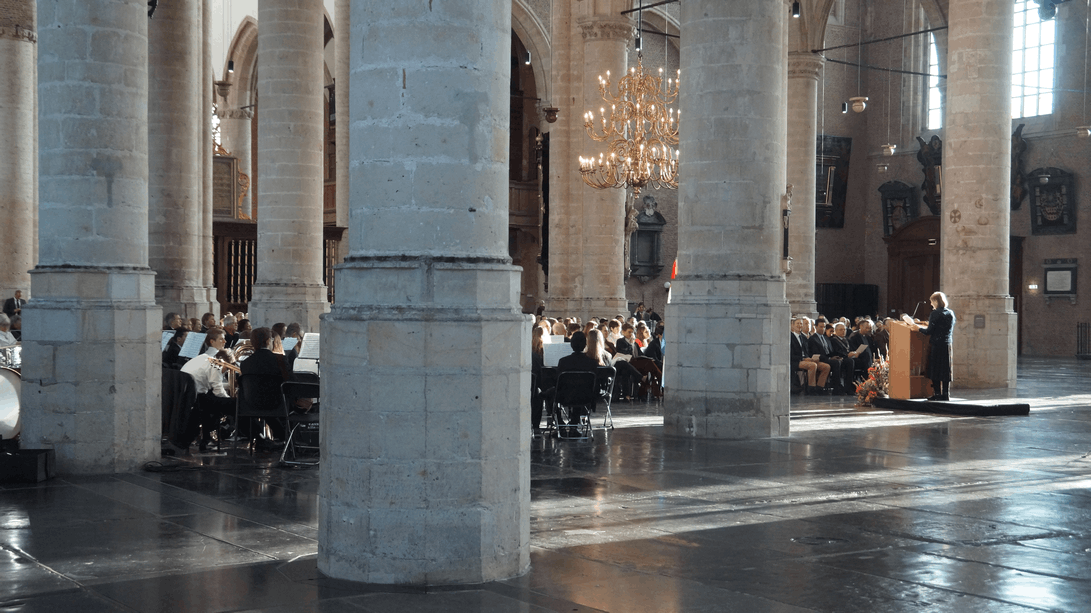
Dutch Mayflower descendant Ria Van der Voort-Koet speaking during the Thanksgiving service in the Pieterskerk in Leiden.
links
- twitter: Leiden Pilgrims
- The Mayflower Society
- Pilgrim Hall Museum: Mayflower Passsengers poster
- Mayflower Society: Silver Books
- American Ancestors (NEGHS): Mayflower Families Fifth Generation Descendants, 1700-1880 database
- Marie de Lannoy & Marie le Mahieu; Marie de Lannoy is not your ancestor
- Pilgrim Monuments in Leiden Series
- Bijdragen Leidse Geschiedenis
Copyright © Tamura Jones. All Rights reserved.