2009-04-10 Dutch Manhattan Coin
Manhattan 400
Manna-hatta
Four hundred years ago, the Dutch ship Halve Maen (Half Moon), captained by Englishman Henry Hudson, sailed into the New World. Hudson had been hired by the Verenigde Oostindische Compagnie (United Dutch East Asia Company) to find another passage to Asia.
He did not find that passage but did enter a natural harbour of an island the locals called Manna-hata. That island is now called Manhattan and the harbour is known as New York harbour.
quadricentennial
All that is four hundred years ago, and that calls for all kinds of commemorative actions and special events.
There is an Amsterdam / New Amsterdam: The Worlds of Henry Hudson in the Museum of the City of New York (MCNY). The Van Gogh Museum in Amsterdam collaborates with the Museum of Modern Art in New York to bring the exhibition Van Gogh and the Colours of the Night in both cities. Dutch bicycle producer Batavus has shipped two hundred orange bicycles (400 hundred wheels) to New York to be used in festivities there.
An overview of news and events can be found on the American NY400 and Dutch NLNY web sites.
commemorative coin
Among the special things done to celebrate the quadricentennial is the minting of a commemorative coin. The Manhattan Vijfje (Manhattan Five) is one in a series of commemorative five euro pieces. Some of the other special issues are the Rembrandt Five, the Europe Five, the Van Gogh Five and, of course, the Australia Five, for 400 years relations with Australia.
design
Dutch design
Each of these coins has been designed by Dutch designer. The Manhattan Five has been designed by Ronald van Tienhoven, an artist who teaches industrial design at the Technical University of Eindhoven. The letter type used is FontShop’s ff Meta designed by Erik Spiekerman.
The overall design of the coin, a map of Manna-hata of 1609 on side and a map Manhattan of 2009 on the other side is not just appropriate, but considerably more original than that brief description conveys.
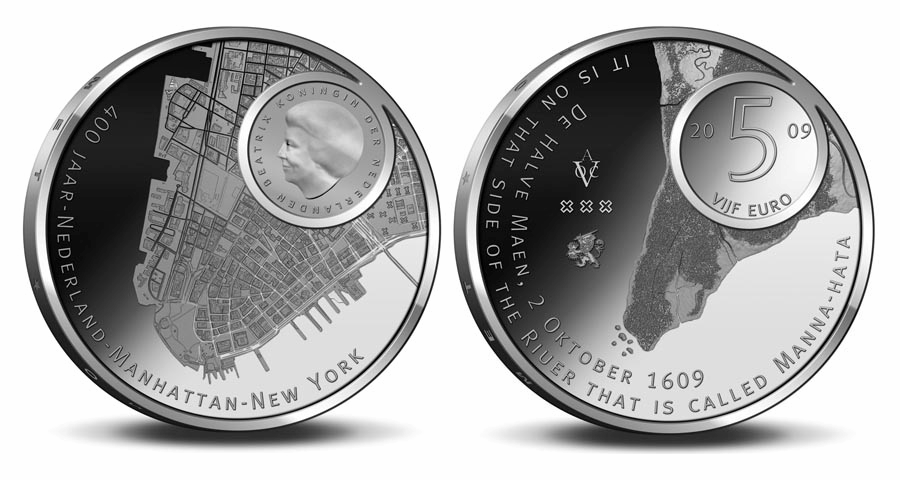
coin within a coin
The coin has a coin-within-a-coin design. It is noteworthy, and it is how we recognise the coin a five Euro piece, but I think the coin would have looked much better and more impressive without it.
3D maps
The really interesting part are the maps. These are not simple drawings, but highly detailed three-dimensional maps. The coins are slightly concave, somewhat thinner in the middle, to keep the 3D relief below the rim.
The Manhattan Five is the technologically most challenging design the Royal Dutch Mint has produced. Laser techniques were used to etch the microscopic detail into the coin.
Ground Zero is easily visible. You can feel the terrain with your fingertips, but you need a spyglass or microscope to appreciate all the details.
The 3D map of modern-day New York was created from data provided by Google Earth. The map of Manna-hata was created from data provided by the Wildlife Conservation Society’s Mannahatta project.
The scale of the maps is 1: 93.500 for both. The modern Manhattan does not just look bigger, it is bigger, Manhattan has grown through reclamation of of land.
symbols
There are various symbols on the coin. The Mercury staff is the sign of the current mint-master, found on all Dutch coins. You have to look closely to find this one. It is just below the sails shown on the Manhattan 2009 side.
The position of the sails marks the position of the Halve Maen on 1609 Oct 2, the date on which the name Manna-hata is first mentioned in the ship’s log.
The coin shows the Amsterdam VOC logo, the Amsterdam crosses and a Dutch rampant lion on the 1609 Manna-hata side.
three versions
There are three variations of this coin
- a silver-plated € 5 circulation coin
- pure silver commemorative € 5 coin
- golden € 10 commemorative coin
The issue price for the golden coin is € 224,95. The issue price for the silver coin is € 30,95. The issue price for the silver-plated circulation coin is € 5. Wealthy collectors can buy a prestige set containing all three for € 599,00.
circulation coin
The circulation coin is heavily silver-plated copper (CU99Ag), has a diameter of 29 mm and a mass of 10,5 g.
This coin can be obtained from any Dutch post office as long as supplies last. It is provided in credit card packaging, with a brief description and a link to the herdenkingsmunt (commemorative coin) web site for more information. You can pay with it, but probably don’t want to take it out of its packaging.
Only 350.000 of these coins have been minted, and they are sure to be sold out soon, be popular with numismatist, and rise in value. The special first day issue of the coin, limited to 2009 copies, which could only be bought in the shop of the Royal Dutch Mint, sold out immediately.
links
coin
- herdenkingsmunt (Dutch)
- Koninklijk Nederlandse Munt (Dutch)
data
font
- FontShop
- Erik Spiekermann (German)
commemoration
- NLNY.nl (Dutch)
- Museum of the City of New York: Amsterdam / New Amsterdam: The Worlds of Henry Hudson
- Batavus (Dutch)
mentioned museums
Copyright © Tamura Jones. All Rights reserved.